4th of July Beach Bag Pattern
4th of July Beach Bag Crochet Pattern
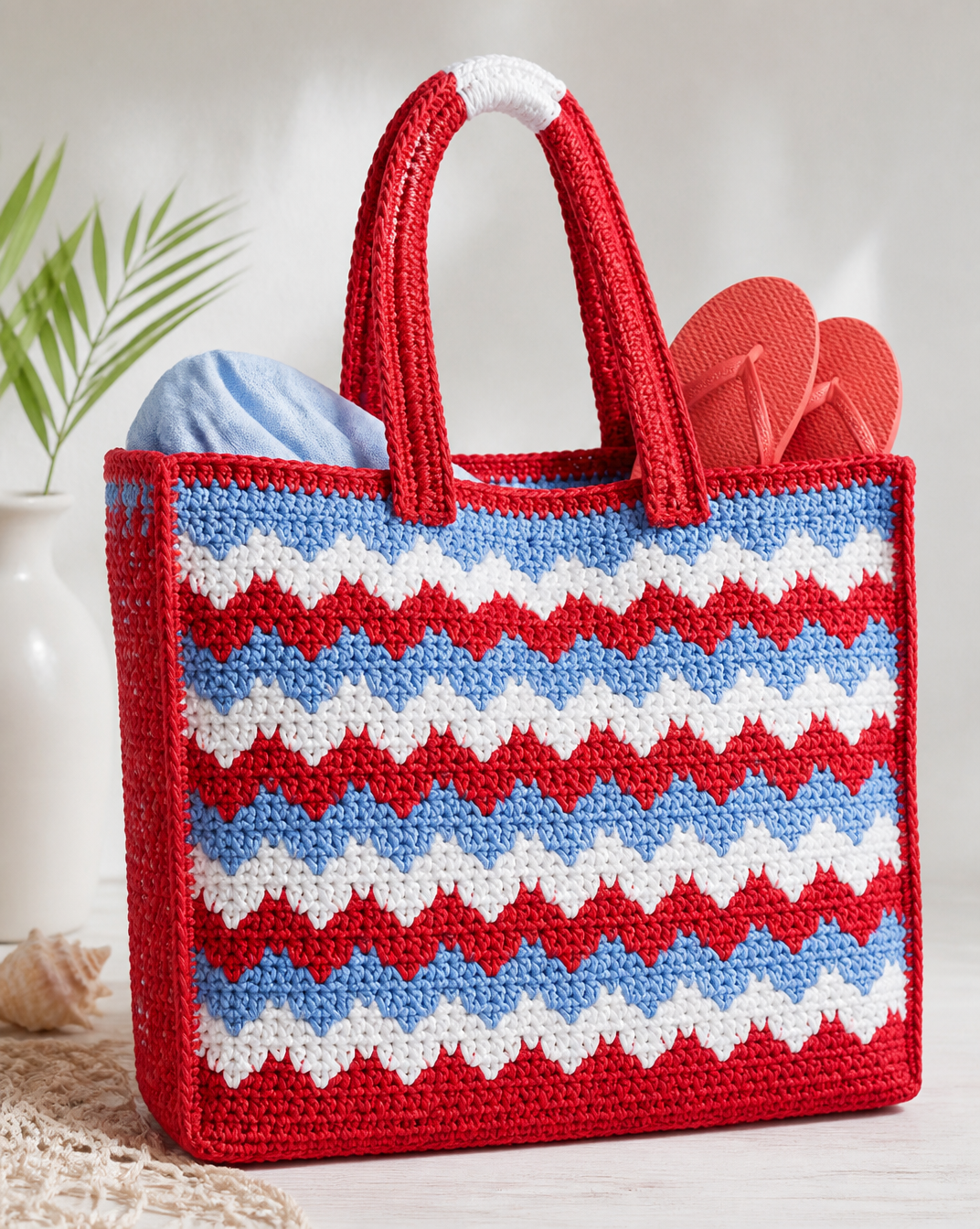
This 4th of July Beach Bag Pattern creates a striped crochet tote from separate front, back, side, and base pieces. The project uses two strands of yarn held together throughout the main construction, with contrasting colors worked into a repeating stitch pattern. After the panels are joined, a crocheted base, reverse single crochet edging, and two sewn handles complete the bag.
This article presents the supplied pattern in a clear, step-by-step format. It includes the yarn choices, hook information, abbreviations, panel instructions, joining details, handle assembly, and source-based checkpoints. Because the source does not provide a finished size, gauge measurement, skill level, or care instructions, those details are identified as Not specified rather than estimated.
Project Overview
The tote is constructed from:
- Two front and back panels.
- Two side panels.
- One crocheted base.
- One top edging worked in reverse single crochet.
- Two crocheted handles.
The front and back panels begin with 49 chains and are made with two strands of Contrast C held together. The side panels begin with 37 chains and follow the supplied front and back panel instructions before continuing to the stated length. The base begins with 49 chains and is worked in single crochet rows until it measures 12 inches [30.5 cm].
Color changes are incorporated into the stripe pattern. Contrast A, Contrast B, and Contrast C are used at specific points in the construction, while Contrast B is also used for joining, top edging, and handles. The pattern specifies a 5 mm crochet hook, identified as U.S. H or 8, or the size needed to obtain gauge.
⚠ Source note: The supplied instructions do not state the finished bag dimensions, gauge, skill level, estimated completion time, care instructions, or a complete color-by-row stripe schedule. Do not infer these specifications from the measurements given for individual pieces.
{image_template}
Materials
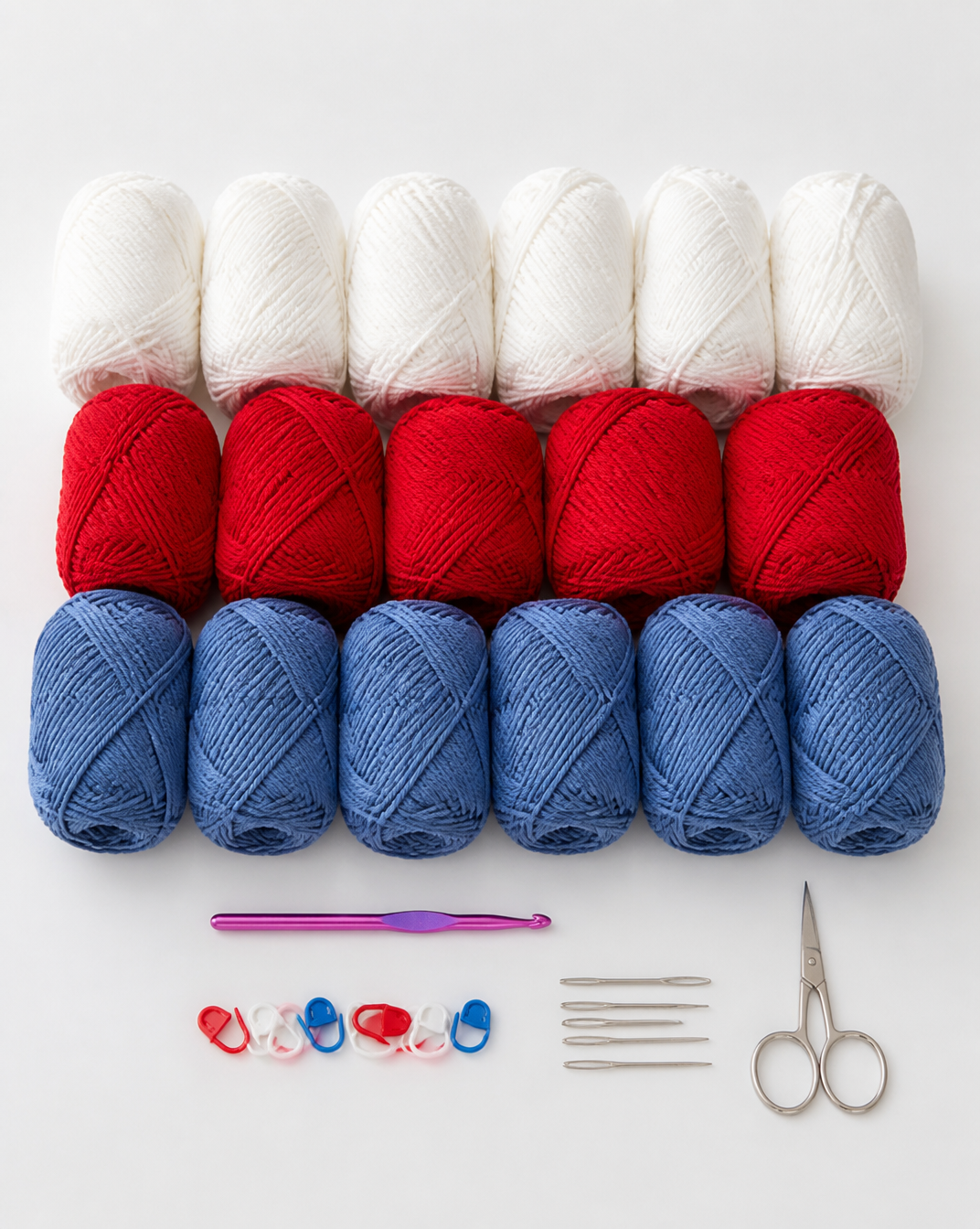
Choose one yarn option. The source lists two alternatives: Solids or Ombres. Do not combine the quantities between the two options unless you independently determine the required amount.
| Item | Source specification | Quantity or notes |
|---|---|---|
| Yarn option 1: Lily® Sugar’n Cream Solids | 70.9 g / 2.5 oz / 109 m / 120 yds per ball | Contrast A, 00001 White: 6 balls Contrast B, 00095 Red: 5 balls Contrast C, 00028 Delft Blue: 6 balls |
| Yarn option 2: Lily® Sugar’n Cream Ombres | 56.7 g / 2 oz / 86 m / 95 yds per ball | Contrast A: 7 balls Contrast B: 6 balls Contrast C: 7 balls |
| Crochet hook | Size 5 mm (U.S. H or 8) | Use the stated hook or the size needed to obtain gauge. |
{image_2}
Abbreviations and Pattern Notes
The source uses standard crochet shorthand, but it does not provide a separate abbreviation key. The meanings below are based on the terms used directly in the supplied instructions.
| Abbreviation | Meaning confirmed by the instructions |
|---|---|
| ch | Chain |
| sc | Single crochet |
| hdc | Half double crochet |
| dc | Double crochet |
| sl st | Slip stitch |
| RS | Right side |
| WS | Wrong side |
| tog | Together |
| Yoh | The source uses this abbreviation in the decrease instructions; its expanded meaning is not separately defined in the supplied text. |
Important notation: When the pattern says to hold two strands together, work with two strands of the indicated color at the same time. “Rep” means repeat, “pat” means pattern, and “cont” means continue. “Miss” means skip. “Fasten off” marks the end of a piece or section.
In the second row of the front and back panels, “1 dc in first sc (counts as 2 dc)” means the beginning chain and the double crochet in the first single crochet together count as two double crochets. The pattern also specifically identifies the decreases Dc2tog and Sc2tog.
⚠ Source warning: The supplied text contains the phrase “Work from to as given for Front and Back Panels” for the side panels, but the beginning and ending references are missing. That wording is retained below, and the source does not identify a replacement range.
Before You Begin
- Choose either the Solids yarn option or the Ombres yarn option.
- Prepare a size 5 mm (U.S. H or 8) crochet hook, or use the size needed to obtain gauge.
- When the instructions call for two strands of a color held together, use both strands as one working yarn.
- Make two front and back panels, two side panels, one base, and two handles.
- Follow the color changes exactly as written. The first three rows establish the Stripe Pat, after which the last two rows are repeated.
- Pay attention to whether an instruction is worked in rows or rounds. The panels and base are worked in rows; the base is joined to the panels with a round, and the top edging is also worked in a round.
- Keep track of RS and WS placement during assembly. The source specifically identifies which sides of the base and joined panels should face during the base attachment.
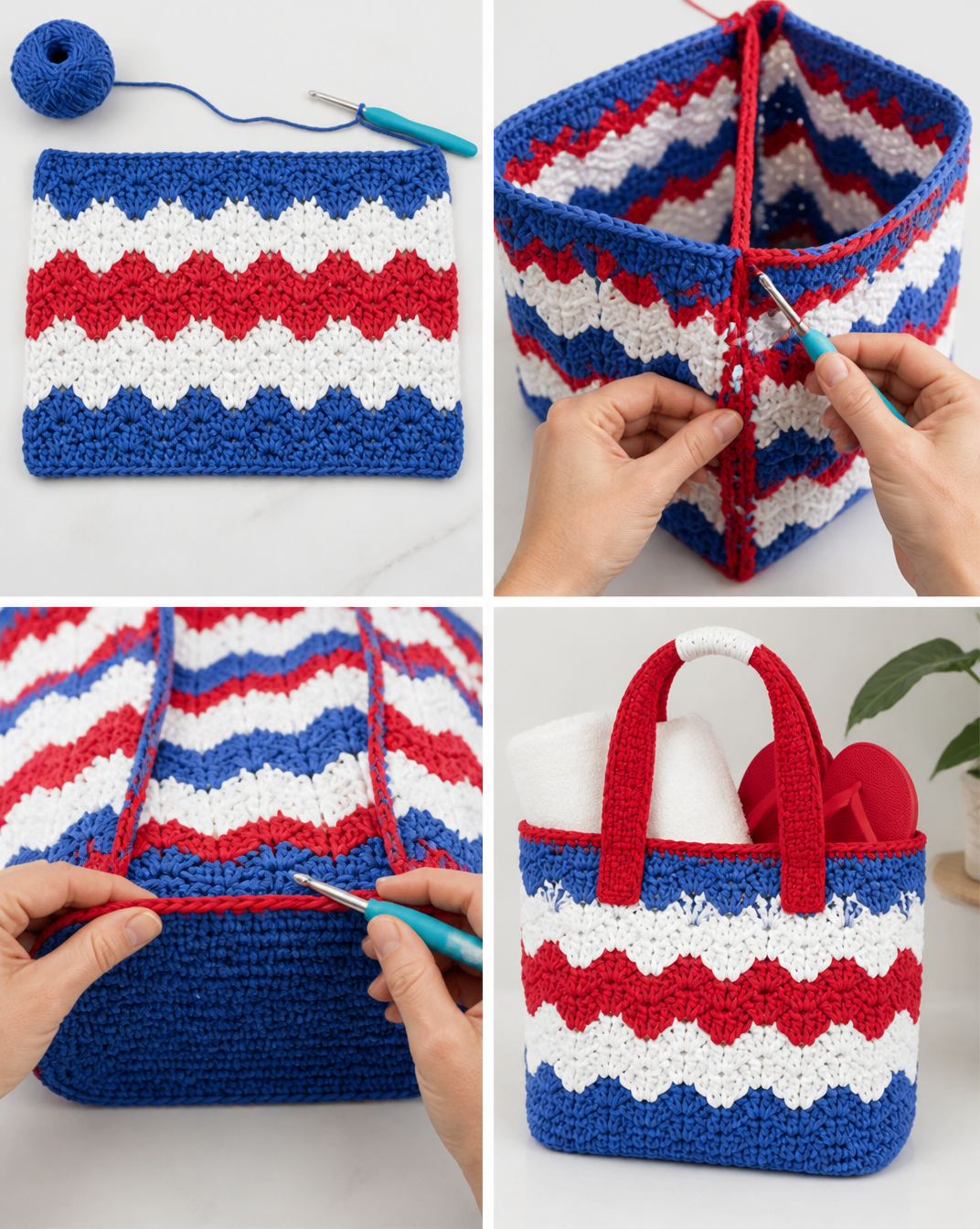
Detailed 4th of July Beach Bag Pattern
Front and Back Panels — Make 2
Make two identical panels. Begin with two strands of Contrast C held together.
- With 2 strands of C held together, chain 49.
- 1st row: 1 sc in 2nd ch from hook. 1 sc in each of next 3 ch. *1 hdc in next ch. 1 dc in each of next 2 ch. 1 hdc in next ch. 1 sc in each of next 8 ch.* Rep from * to last 8 ch. 1 hdc in next ch. 1 dc in each of next 2 ch. 1 hdc in next ch. 1 sc in each of next 4 ch. Turn.
- 2nd row: Ch 3. 1 dc in first sc (counts as 2 dc). *1 dc in each of next 3 sc. (Yoh and draw up a loop in next st. Yoh and draw a loop through 2 loops on hook) twice. Yoh and draw through all loops on hook – Dc2tog made. Dc2tog over next 2 sts. 1 dc in each of next 3 sc. (2 dc in next sc) twice. Rep from *, ending with: 2 dc in next sc.* Join A. Turn.
- 3rd row: With A, ch 1. 2 sc in first dc. *1 sc in each of next 3 dc. Draw up a loop in each of next 2 sts. Yoh and draw through all loops on hook – Sc2tog made. Sc2tog over next 2 sts. 1 sc in each of next 3 dc. (2 sc in next dc) twice. Rep from *, ending with 2 sc in top of turning ch.* Turn.
The first three rows of the Stripe Pat are now completed.
- Keeping cont of Stripe Pat, rep last 2 rows until work from beg measures approx 14 ins [35.5 cm], ending with 2 rows of B.
- Next row: With A, ch 1. 2 sc in first dc. *1 sc in each of next 3 dc. (Sc2tog over next 2 sts) twice. 1 sc in each of next 3 dc. Ch 4. Miss next 2 dc. 1 sc in each of next 3 dc. (Sc2tog over next 2 sts) twice. 1 sc in each of next 3 dc.* 2 sc in each of next 2 dc. Rep from * to * once more. 2 sc in top of turning ch. Turn.
- Next row: Ch 3. 1 dc in first sc (counts as 2 dc). *1 dc in each of next 3 sc. (Dc2tog over next 2 sts) twice. 1 dc in each of next 2 sts. 6 dc in next ch-4 sp. 1 dc in each of next 2 sts. (Dc2tog over next 2 sts) twice. 1 dc in each of next 3 sc.* *2 dc in each of next 2 sc. Rep from * to * once more.* 2 dc in last sc. Join C. Turn.
- Work a further 2 rows in pat. Fasten off.
Side Panels — Make 2
- With 2 strands of C tog, ch 37.
- Work from to as given for Front and Back Panels.
- Cont in Stripe Pat until work from beg measures 16 ins [40.5 cm].
- Fasten off.
⚠ Missing source reference: The side-panel instruction does not specify which portion of the Front and Back Panel directions should be used because the references after “from” and “to” are absent. Preserve the supplied wording and verify this point against the original source before beginning the side panels.
Join Panels
- Arrange Panels to form a rectangle, having Side Panels opposite each other.
- With WS of 2 Panels tog, join 2 strands of B with sl st to top left corner.
- Ch 1.
- Working through both thicknesses, work 1 row of sc evenly along side edge.
- Fasten off.
- Rep for rem Panels.
Base
- With 2 strands of C, ch 49.
- 1st row: 1 sc in 2nd ch from hook. 1 sc in each ch to end of ch. Turn. 48 sc.
- 2nd row: Ch 1. 1 sc in each sc across. Turn.
- Rep last row until work from beg measures 12 ins [30.5 cm], ending with a WS row.
- Do not fasten off.
Join Base to Panels
- With RS of Base facing, place lower edge of joined Panels behind Base with WS of work tog, aligning corners of Base with joining rows of Panels.
- Next rnd: Ch 1.
- Working through both thicknesses, work 1 rnd of sc evenly around all 4 sides of Base.
- Join with sl st to first sc.
- Fasten off.
Top Edging
- With RS of work facing, join 2 strands of B with sl st to any corner of top edge.
- Ch 1.
- Working from left to right instead of right to left as usual, work 1 rnd of reverse sc evenly around top edge.
- Join with sl st to first sc.
- Fasten off.
Handles — Make 2
- With 2 strands of B, ch 95 loosely.
- 1st row: 1 sc in 2nd ch from hook. 1 sc in each ch to end of ch. Turn. 94 sc.
- 2nd row: Ch 1. 1 sc in each sc to end of row. Turn.
- Rep last row once more.
- Fasten off.
Assembly and Finishing
After the tote body has been joined and the top edging has been completed, attach the handles as directed. The source describes the handle placement in relation to the slits of the Front Panel and Back Panel.
- With RS of Tote facing, push ends of Handle through slits of Front Panel to WS.
- Sew ends tog.
- Bring halves of Handle tog.
- Taking 2 strands of A tog, wrap center 4 ins [10 cm] of Handle as shown in picture.
- Fasten ends securely.
- Rep for Back Panel.
Finishing Checklist
- ✓ Two front and back panels have been made.
- ✓ Two side panels have been made.
- ✓ Side panels are opposite each other in the arranged rectangle.
- ✓ Panel edges have been joined through both thicknesses with two strands of B.
- ✓ The base has been worked to 12 ins [30.5 cm] and remains attached until it is joined to the panels.
- ✓ The base has been joined through both thicknesses around all four sides.
- ✓ The top edge has received one round of reverse sc in B.
- ✓ Two handles have been made from a chain of 95 and three rows of single crochet.
- ✓ Handle ends have been pushed through the panel slits, sewn together, and wrapped at the center with two strands of A for 4 ins [10 cm].
Source-Based Checkpoints
Use these checkpoints while reading and making the pattern:
- Yarn selection: Choose one complete yarn option. The Solids and Ombres quantities are different.
- Two strands: The front and back panels, side panels, base, joining, edging, and handles specify two strands at the stated color points.
- Front and back panel length: Continue the Stripe Pat until the work measures approximately 14 inches [35.5 cm], ending with 2 rows of B.
- Side panel length: Continue in Stripe Pat until the work measures 16 inches [40.5 cm].
- Base stitch count: The first base row explicitly ends with 48 sc.
- Base measurement: Continue until the base measures 12 inches [30.5 cm], ending with a WS row, and do not fasten off before joining.
- Top edging direction: Reverse sc is worked from left to right instead of right to left as usual.
- Undefined or incomplete text: The side-panel phrase “Work from to as given for Front and Back Panels” contains missing references. The source also refers to a picture for the handle wrapping, but no picture is included in the supplied material.
{image_1}
Frequently Asked Questions
How many panels are needed for the beach bag?
The pattern calls for two front and back panels and two side panels. These pieces are arranged to form a rectangle before the base is attached.
Which yarn can be used for this crochet beach bag?
The source provides two choices: Lily® Sugar’n Cream Solids or Lily® Sugar’n Cream Ombres. Each option has its own ball quantities and meterage information. Choose one option rather than combining the listed quantities.
What crochet hook size is required?
Use a size 5 mm crochet hook, identified in the source as U.S. H or 8, or use the size needed to obtain gauge.
What are the measurements given in the pattern?
The front and back panels measure approximately 14 inches [35.5 cm] before the special opening rows and final pattern rows. The side panels continue to 16 inches [40.5 cm], and the base continues to 12 inches [30.5 cm]. A finished bag size is not specified.
How are the panels joined?
The panels are arranged with the side panels opposite each other. Two strands of B are joined with a slip stitch at the top left corner, and one row of single crochet is worked evenly through both thicknesses along the side edge. This is repeated for the remaining panels.
How is the base attached to the bag?
With the right side of the base facing, place the lower edge of the joined panels behind the base with the wrong sides together. Align the base corners with the panel joining rows, then work one round of single crochet evenly through both thicknesses around all four sides of the base.
Does the source include a gauge or care recommendation?
The source mentions using the hook size needed to obtain gauge, but it does not provide a gauge measurement. Care instructions are also not specified.
Conclusion
This 4th of July Beach Bag Pattern is assembled from crocheted panels, a structured single-crochet base, a reverse single crochet top edge, and two handled straps. The supplied color changes and two-strand construction create the project’s stated striped design. Follow the panel sequence, preserve the stated measurements and stitch counts, and check the incomplete side-panel reference against the original source before proceeding.